Protein crystallographer and instrument scientist who cares about the best possible data, loves code and Linux, and enjoys helping people grow.
I'm a Senior Beamline Scientist at Diamond Light Source, the UK's synchrotron, a proud dad, and an uncle to the next generation. I've spent most of my working life around X-rays and protein crystals. Since 2011 I've worked in beamline science rather than as a full-time researcher, looking after the whole chain that turns a crystal into good data: the hardware and electronics, the code and Linux systems that drive them, and the people who use them, from visiting scientists to the colleagues I train. I love a good problem, and it's even better when someone else's science gets the win.
How I got here
I was born in Lisbon in 1976, spent most of my childhood in Pocariça and my teens in Linda-a-Velha, and these days I'm both Portuguese and Australian. I started out in organic chemistry at FCT NOVA in 1994. That same year my uncle, António Câmara (who later won the Pessoa Prize), invited me to help at GASA, his environmental systems group at FCT NOVA, where I stayed until 1999. My job was humble: typing data from paper into databases so it could become features in virtual worlds, for projects that included a multimedia CD-ROM for Expo 98. It was written up as a book chapter, so my first publication has nothing to do with proteins. It was also where I first sat at a Silicon Graphics workstation wearing VR shutter glasses, which turned out to be handy: when I started in protein crystallography in 1998, we built models in O and TURBO-FRODO on the same kind of SGI machines.
In 1998 I started an undergraduate project in protein crystallography at ITQB NOVA in Oeiras, supervised by Pedro Matias, building the model of the split-Soret cytochrome c into the electron density. I also crystallised a seven-iron ferredoxin from a heat-loving archaeon, Acidianus ambivalens. Its crystals diffracted to 2.0 Å but were twinned, so the structure took its time: it came out in 2008. That December I spent a week at a CCP4 workshop on refinement in York. The university had run out of rooms, so Jorge Navaza, the author of the molecular replacement program AMoRe, kindly put me up in the place he was renting. From July to October 1999 came my first placement, at EMBL in Grenoble on the ESRF site, working on radiation damage in protein crystals with Raimond Ravelli, a wonderfully creative scientist who is dearly missed. From early 2000 I had a research initiation grant (BIC) in Carlos Frazão's group at ITQB, first refining a dimeric cytochrome c3 to 1.2 Å and then on the hybrid cluster protein. Ricardo Coelho and I spent a week in Juan Fontecilla-Camps's lab at the IBS in Grenoble learning to freeze crystals in liquid propane inside an anaerobic chamber, and brought the trick back to Oeiras. From September to November 2000 I was at the University of Georgia in the lab of Jean LeGall, who first described the bacterium Desulfovibrio gigas, purifying proteins in anaerobic glove boxes. Ricardo Coelho was there too, purifying proteins with me; one of those we wanted to bring back to Oeiras was a hydrogenase that stopped working if it saw any oxygen. After that, flasks of organic compounds couldn't compete with proteins and their crystals.
From October to December 2001 I went back to Grenoble for a second spell, this time at the ESRF with Ed Mitchell, who would later co-supervise my PhD. The plan was to learn phasing properly: I grew new crystals of the hybrid cluster protein without oxygen, collected data at three wavelengths around the iron edge, solved the structure by MAD and refined it to 1.3 Å, and learned XDS along the way, having only used MOSFLM and DENZO/SCALEPACK until then. Early in 2002 came HERCULES, a six-week course in Grenoble for scientists who use large facilities such as synchrotrons and neutron sources. Six weeks of lectures and experiments with PhD students from all over Europe made for close friendships: that autumn I was at a new friend's wedding in Rome, and these days we both live in the UK and are still friends. ITQB is where Larry Sieker and Ricardo Coelho taught me how to crystallise proteins, and most of what I know about crystallisation I still owe to them. My PhD (2002–2007), on an FCT scholarship, was in Maria Arménia Carrondo's lab, split between ITQB and the ESRF, with Carlos Frazão and Ed Mitchell as my supervisors. Grenoble is where I fell for synchrotrons, and I've never quite got over it.
In December 2002 I'd done an EMBO practical course on protein expression, purification and crystallisation (PEPC3) at EMBL Hamburg, and it came in handy. Around the end of 2003, halfway through the PhD, I took on a second project: Maria Arménia set up a collaboration with Isabel Sá-Correia's group at IST in Lisbon. Our lab had always worked on metalloproteins, purified the way Jean LeGall taught: grow huge cultures and extract the proteins the bacteria make in abundance. So I became the first in the lab to overexpress a protein and to make it with selenomethionine. The IST team knew overexpression but not selenomethionine, so we learned together, and my thesis was better for having both proteins in it.
The new protein was UgpG, a glucose-1-phosphate uridylyltransferase, and by early August 2005 I had seven crystal forms and no structure. Molecular replacement wasn't getting anywhere, and the selenomethionine data had 88 selenium sites to find (11 in each of the 8 molecules), which was no small job. In the early hours of the last day of beam before the ESRF's August shutdown, an osmium derivative started showing a lovely anomalous signal, but the machine was due to be switched off before I could finish. Ed told me straight: there wasn't enough time, and if I wanted the structure before the shutdown I'd have to ring the control room and ask them to keep the machine running. Was that even possible? He didn't know, and he wouldn't make the call for me: my decision, my phone call. With shaking hands and a wobbly voice, I rang. They said yes. The whole ESRF kept running for another 25 minutes because of me, and that was enough for a complete, highly redundant dataset and a solved structure. The selenium sites earned their keep later, pinning down the sequence in maps that weren't easy to build into. I spent the rest of the summer building, and by the end of September I had a complete, refined structure (paper).
Next came membrane proteins with Martin Caffrey: first at the University of Limerick, as a postdoc on his US National Institutes of Health grants, and then at Trinity College Dublin on my own Marie Curie fellowship (the first grant I wrote, and the first I won), working on ABC transporters from Pseudomonas aeruginosa. Limerick was a leap. The lab had no crystallography of its own yet (until then it had been done with outside collaborators), so my first jobs were booking synchrotron beamtime and buying the loops, dewars and the rest of the kit we needed to collect data at all. As the resident crystallographer I was involved in every project, which made for exciting, rewarding and very busy years: between 2008 and 2011 I ran 31 trips to synchrotrons, about one a month, most of them to the Advanced Photon Source near Chicago, and others to the Swiss Light Source, the ESRF and Diamond.
After a few trips on my own, especially the 48-hour blocks of beamtime the APS gave us every month, I realised I needed help, so I started bringing students from the lab along, sometimes before they had crystals of their own. That's where I found out how rewarding it is to help other people grow, as scientists and as people. My imposter syndrome was loud: what if we hit a crystallographic problem I didn't know how to solve? We grew crystals inside the lipidic cubic phase, a lipid gel with roughly the texture of toothpaste, and some of that work ended up in Nature, including a receptor structure with Brian Kobilka's group. I'd love to tell you it was all part of a grand plan. It wasn't. It was good mentors, great colleagues and a lot of crystals that didn't grow. And plenty of willpower and persistence too, for example in learning to get crystals out of the glass sandwiches we grew them in.
In 2011 I swapped research for beamline science at the Australian Synchrotron in Melbourne, where Tom Caradoc-Davies hired me and was my manager and mentor for the next eight years. He had a lot of patience with me, kept encouraging me to chase what I wanted to do, and turned a keen but fairly ordinary academic into an instrument scientist.
The doubts still came back, in a new form: suddenly I was the person who was meant to know why the robot had stopped, the detector had gone quiet or the data looked strange. My cure has always been the same: learn the thing properly, write it down, and share it. I wrote elog entries and mini how-tos about everything, rather selfishly at first, even for problems other people had fixed, because I thought I might need them one day. Over two or three years that habit made me the go-to troubleshooter, and the notes became one of the best sources of know-how on the beamlines. By 2018 I'd written more than 4,000 entries in the facility logbook, the second most of anyone there. Outside the beamline, seven years on the SCANZ executive taught me how much a small society can do with good volunteers (and a decent membership database). I also helped prepare the winning bid to bring the 2023 IUCr World Congress to Melbourne, and then joined its organising committee. Python courses, two Red Hat certifications and many patient colleagues later, it still works.
In 2019 I moved to Diamond in Oxfordshire, just in time for a pandemic. During the lockdowns I was one of the key workers keeping I04 running for the COVID Moonshot.
Since then, much of my work on I04 has been about quality, and about making good data easier to get. I brought the checklist habit with me: a software beamline setup checklist, now MX Beamline Setup, so every start-up is checked the same way and nothing depends on someone's memory. I led the move to dose-aware and then dose-driven data collection: first making users aware of the X-ray dose their crystals were getting, then letting the beamline choose exposures from a target dose (2025 paper). At IUCr 2026 I set out the wider framework for teaching and collecting data this way in a poster, Strategic dose allocation. In 2024 and 2025 I led a BBSRC-funded project that brought machine-learning sample centring to I04. I also teach data collection at CCP4 workshops every year since 2019, some years at two different schools, and every year on Diamond's own MX user training, which is where all those old notes keep paying off. In 2026 that training was split into three courses for different levels of experience; I taught on the introduction for new users in February. For Diamond's 2026 Beyond Automation course I came up with four hands-on case studies for I04, from detector count-rate problems that merging statistics hide to spreading the dose along needle crystals. I ran two of them and colleagues ran the other two, and I drew each one as a comic strip (with some AI help).
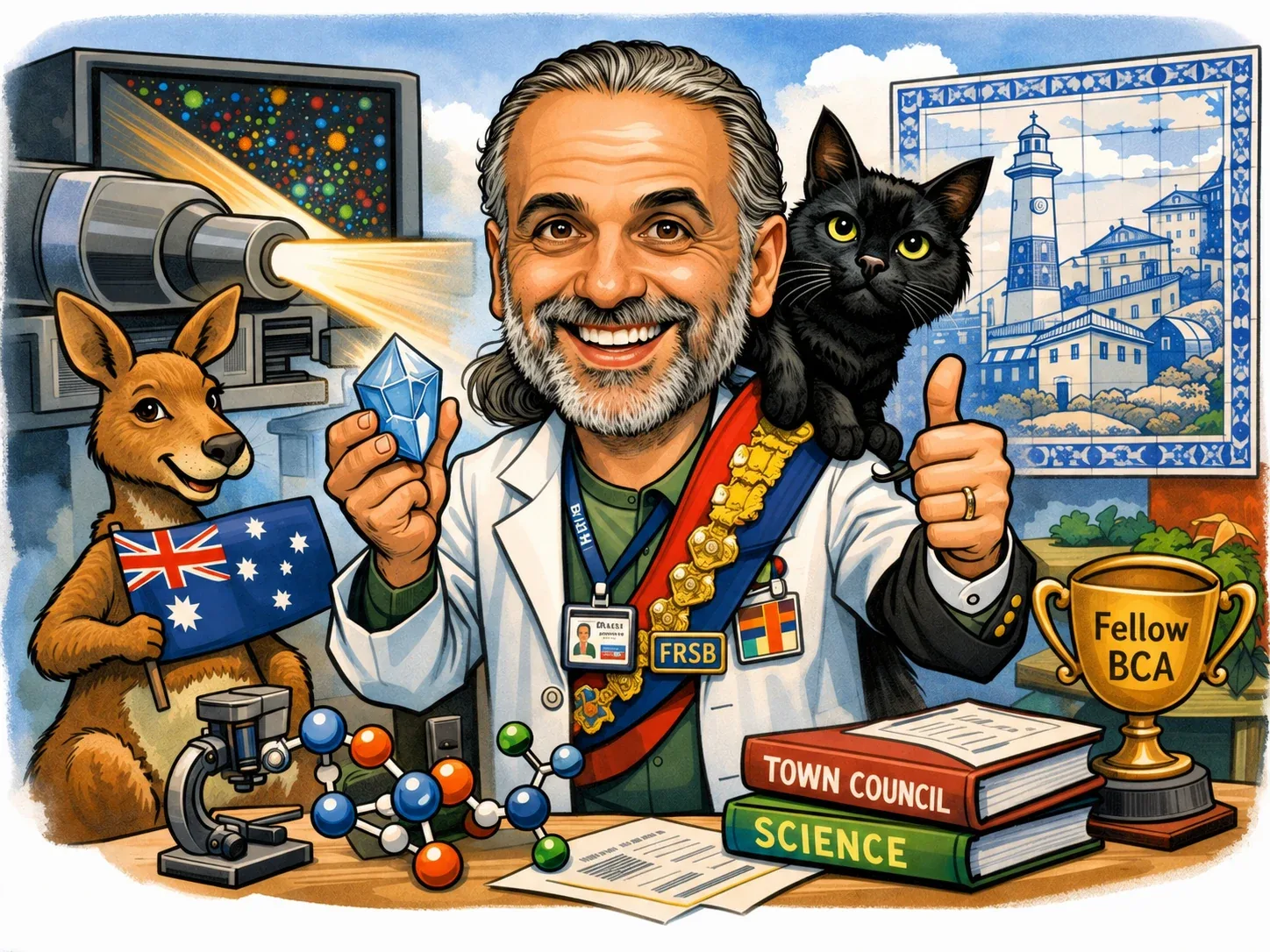
Me in 2026, drawn with AI help.
These days I also co-supervise PhD students (at the moment Paige Taylor, who has just moved from Australia to Diamond) and train new colleagues to become instrument scientists, trying to pass on some of the patience so many people showed me. I'm also a mental health first aider at work, sit on Didcot Town Council, and still get a small thrill every time a new structure appears out of the data. Enough of a thrill that I wrote a display for the screen in front of I04, which shows a rotating loop of newly released structures collected on the beamline. It's an idea I first tried in Melbourne as the "MX TV", on old screens rescued from recycling.
Current interests
I'm particularly interested in making MX beamlines more automated without compromising the quality of the science or the safety of the equipment, so that robots and goniometers don't collide and the direct beam never reaches a detector. That includes better ways to collect data with modern pixel-array detectors, collecting complete datasets from several wedges on the same or different crystals, the challenges of small and very small X-ray beams (beam stability, a small sphere of confusion and so on), and better ways to process the raw data from all these setups.
I also care about the user's experience of a beamline, whether they're on site or working remotely from their own lab: how experiments are designed, how data collection software presents itself, and how raw data and metadata are archived and shared so the next experiment can learn from the last. Modern beams and detectors produce an overwhelming amount of data, and that calls for fresh thinking rather than doing things the same way again and again. Behind all of that sits the computing, and I still enjoy that side too: Linux, virtual machines, containers and open-source tools that keep a beamline reliable and easy to look after.
In structural biology, I'm drawn to the interfaces of cells and organelles: how bacteria import what they need to survive, how energy is turned into proton gradients across membranes and those gradients into ATP, how viral capsids attach to cells and assemble inside them, and how cargo proteins move molecules into and out of the nucleus, mitochondria and Golgi apparatus.
Just as much, I'm interested in the people who make a facility work: training users and new staff, mentoring early-career scientists, and helping colleagues grow into new roles. Wellbeing matters too; I'm a mental health first aider at work.
I also love talking about science with people who don't do it for a living. Open days energise me like little else, I've given a general-audience talk at the Wantage Café Scientifique, and since 2023 I've joined school career carousels (a sort of speed dating, where teenagers quiz me about my job) and run mock job interviews with students.
Experience
Protein crystallographer
1998–present
I’ve been a regular at macromolecular crystallography (MX) beamlines since 1998, at more than five synchrotrons around the world. Add it up and it comes to over 10,000 hours of data collection, more than 60 structures in the Protein Data Bank, and a fair few crystals that were beautiful under the microscope and diffracted like a brick. I’ve worked on every step, from crystallisation and harvesting to data collection, processing, structure solution, refinement and analysis. I’ve co-authored more than 40 papers, cited over 2,900 times (OpenAlex, October 2026; see Publications).
A few I’m especially glad to have been part of
The structure of the β2 adrenergic receptor bound to an irreversible agonist, with Brian Kobilka’s group (Nature, 2011), part of the body of work recognised by the 2012 Nobel Prize in Chemistry.
How electrons pass from cytochrome c into a caa3-type cytochrome oxidase, one of the key energy-converting steps in cells (Nature, 2012).
The integral membrane diacylglycerol kinase (Nature, 2013), more than four years in the making. Partway through, a structure of the same protein solved by NMR appeared in Science, which was hard to take at first. We kept going, and our crystal structure, pieced together from 18 wedges of data from many crystals and solved by experimental phasing, turned out quite different. I was the lead crystallographer. We later studied the enzyme with X-ray free-electron lasers as well (Nature Communications, 2015).
Showing that small membrane peptides such as gramicidin can be crystallised and solved in the lipidic cubic phase (Biophysical Journal, 2010).
Beamline scientist
2011–present
In 2011 I left my Marie Curie fellowship at Trinity College Dublin for the MX beamlines at the Australian Synchrotron in Melbourne, first as a beamline postdoctoral associate and, from the end of 2013, as a beamline scientist. The synchrotron was still in Victorian state hands then; it moved to ANSTO, the federal government’s nuclear science organisation, in 2016.
Within two or three years I’d become the go-to person when the hardware or software misbehaved. I put that down to stubbornness, a soft spot for quality control and a habit of writing everything down: elog entries and short how-tos about what broke and how it was fixed, even when someone else had done the fixing. Over the next eight years I was closely involved in:
the design and software of a microservices-based beamline control system to replace Blu-Ice;
yaIBEX, a browser-based interface for collecting data (Python and Flask), which became the basis of the click-to-centre and robot controls on both beamlines (AOFSRR 2015 abstract). Driving a beamline from a web browser was a little ahead of its time in 2014; MXCuBE3, announced in 2017 and now used at many synchrotrons, later took a very similar approach;
browser-based remote access with Apache Guacamole, and moving the beamline computers onto virtual machines;
hands-on upgrades of the SAM sample-changing robots;
the project team for the microfocus beamline’s monochromator upgrade, designed with FMB Oxford: electric heaters instead of water lines (which had frozen more than once, one time flooding a vacuum chamber), low-vibration liquid-nitrogen lines, a stiffer crystal stage and a channel-cut crystal. I ran the before-and-after vibration study, shaking the monochromator’s table with a seismic thumper from 20 to 200 Hz (a joy, honestly), which showed a steadier beam that shrugged off outside vibration much better (MX2 beamline paper);
keeping the old goniometer going with an emergency air-bearing replacement in 2015, then project-managing its successor, built with Aina Cohen’s team at SSRL from their BL12-2 design, from design and manufacture through installation and acceptance testing. It centres samples with a sphere of confusion better than 1 µm (MX2 beamline paper);
the upgrade to an EIGER 16M detector in January 2017, where I rewrote much of the data-collection software to drive it, described in two papers;
helping start the MX commercial programme (including a 2013 trip to talk to companies in China and Japan) and the Collaborative Access Program for academic users.
I also learned a lot about time management, teamwork and conflict resolution, mostly by getting them wrong first and then a bit less wrong.
In 2018 ANSTO’s Research Merit scheme moved me to the senior scientist band, while I carried on doing the same job.
In 2019 I joined Diamond Light Source, the UK’s national synchrotron in Oxfordshire, as a Senior Beamline Scientist on I04. My first year came with a pandemic: as a designated key worker I helped keep I04 running for the international COVID Moonshot. Since then I’ve led:
dose-driven data collection, where RADDOSE-3D runs as a service and the beamline picks exposures from a target dose, so users get good data without having to become experts in radiation damage first. When I arrived, I04’s top speed was about 21 samples an hour. With dose-driven and unattended collection it now runs at about 30 (we gave up a little speed for stability, and we’re working on getting it back);
a ten-module induction course for new MX support scientists (run in 2020, 2023 and 2025), and the on-call rota for nights and weekends.
I’ve also been a tutor on the data-collection part of CCP4 workshops every year since 2019, some years at two different schools, taught every year on Diamond’s MX user (BAG) training, including the new introduction for new users in February 2026, and in 2026 I designed the four I04 case studies for Diamond’s Beyond Automation training course, running two of them myself.
Linux, networks and open source
1995–present
It started with games. To play over a network with my cousins, who lived in other flats in the same building, I set up a Windows network, with old BNC coaxial cable (terminators and all) running out through the windows to their flats. After a while I moved to Linux, because it let me learn the layer below: how operating systems, networks and the internet actually work. It helped that the university had plenty of Linux machines, and that at GASA I worked on Silicon Graphics workstations running IRIX, SGI’s UNIX. In the mid-1990s all this meant a lot of patience and a lot of floppy disks. My first paid job was setting up SUSE Linux computers for undergraduate chemical engineering classes.
Linux is also about an idea: software, and the know-how behind it, is better when it’s shared. I was an active member of ANSOL, the Portuguese free software association, helped out at Linux installation parties in the early 2000s, and have been a member of the Free Software Foundation since 2003.
Wherever I’ve worked, I’ve ended up looking after the computers as well as the science:
ITQB NOVA, Oeiras: Linux workstations and servers for crystallography, from the SGI machines we used for model building to Red Hat, Debian and Slackware boxes.
Limerick and Trinity College Dublin: setting up the lab’s crystallography computing from scratch, and helping arrange access to high-performance computing at Trinity.
Australian Synchrotron (2012–2019): unofficially, the system administrator for the two MX beamlines, and where virtualisation caught my imagination. I led the move of the beamline computers from ageing physical servers to virtual machines and containers on a Proxmox cluster (by 2018 about 95% of them, on ten servers that back each other up), managed the user workstations centrally with SaltStack so every machine behaved the same, set up live backups of the control computers with Mondo Rescue, and replaced the remote-access system with browser-based Apache Guacamole.
Alongside the day job, since 2003 I’ve run cPanel/WHM virtual private and dedicated servers hosting more than 60 domain names. Twenty-odd years of that means Apache, BIND, Exim and sendmail, POP3 and IMAP, TCP/IP networking, filesystems, firewalls and, less happily, investigating and closing the occasional security breach.
I passed the Red Hat Certified System Administrator (RHCSA, May 2012) and Red Hat Certified Engineer (RHCE, November 2013) exams, both on Red Hat Enterprise Linux 6. Red Hat certifications count as current for three years, so mine have long since lapsed, but the habits they built haven’t.
Programming
2001–present
I love writing code, and at work it’s a tool for better experiments: it drives the hardware, collects the data and checks what comes out. When software moves a robot or opens a shutter, it has to know what could go wrong, from a collision to the direct beam hitting a detector, so I care as much about those safety checks as about speed.
I started with Microsoft Visual Basic, building small applications on top of Microsoft Access databases. Running LAMP servers led to PHP/MySQL websites, and from 2004 to 2008 I looked after several sites built on Joomla, WordPress and phpBB (this site ran on Joomla until 2026).
In 2013 Andy Bulka introduced me to Python with a six-week course, one full day a week. Two years later a second six-week course covered advanced Python and object-oriented programming. Those courses, years of hands-on work on the Australian Synchrotron MX beamlines, and everything I picked up from the brilliant coder Nathan Mudie changed how I saw my job. I was no longer just a user of software. I could make it drive hardware, collect better diffraction data and improve the analysis. I’m still learning, and I still Google the syntax.
Selected projects
An attenuator wheel to control X-ray beam transmission at different energies (Beer–Lambert law, with hardware control through Python and EPICS).
Rewriting the automatic data processing in Python on top of xdsme, with fixes accepted upstream by its author.
Moving the auto-processing software to Docker containers on Kubernetes.
Rewriting the Python data-collection server for the move from CCD-based ADSC detectors to an EIGER pixel-array detector.
Extending a Python beamline library that keeps applications independent of the instrument they run on.
Designing the gradual replacement of the monolithic Blu-Ice with a microservices-based ecosystem.
Developing and maintaining BeamlineSetup, a QC-driven beamline setup GUI that delivers high-quality calibration to users. Its successor, MX Beamline Setup, is now developed at Diamond Light Source.
Implementing diffraction rastering for sample centring on the MX beamlines.
The I04 PDB display (React, FastAPI, Valkey and the PDBe Mol* viewer), running on the screen in front of I04 at Diamond. It shows newly released structures collected on the beamline, after checking each entry’s metadata so that structures wrongly credited to I04 (or confused with I04-1) don’t make it onto the screen.
Societies and community
I've always found it hard to say no when a society, a school or a town needs a hand. I think taking part is everyone's job, and somebody has to read the minutes. Quite often, it's been me.
Moved the membership onto proper management software, with online card payments and automatic receipts. Membership grew from about 40 to more than 230, over 100 of them students.
Vice-President, Society of Crystallographers in Australia and New Zealand (SCANZ) (2017–2018)
Helped prepare the winning bid, led by Professor Michael Parker, including lobbying for votes at ECM30 in Basel (2016), then joined the organising committee.
Every year since 2019, some years at two different schools: the Diamond–CCP4 data collection workshops (2019 to 2025), the CCP4/BGU course in Israel (2020) and the CCP4–BCA summer schools (Norwich 2024, York 2025).
Trainer, MX user (BAG) training, Diamond Light Source (2019–present)
Every year since I joined Diamond. In 2026 the training became three courses for different levels of experience; I taught on the introduction for new users (February) and on Beyond Automation (September–October).
Organising committee, Australasian Crystallography School (2013)
Precision at high flux, matching the beam to the crystal, multi-axis collection to fill the blind cone in P1, and helical or wedged line scans for rods and needles. About 25 MX users; each group chose two of the four.
Civic and community
School governor, Millbrook Primary School, Grove (2021–2023)
Town Councillor, All Saints Ward, Didcot Town Council (elected May 2023; term ends May 2027)
Member of the Finance and General Purposes Committee since my election in May 2023, and Vice-Chair of the Personnel and Administration Committee since May 2025. Earlier, a member of the Property and Facilities Committee (2023–2025).
Elected in May 2023 with 865 votes, third of the five councillors elected for the ward.
Outreach and workplace
Open day volunteer (in French), ESRF, Grenoble (2004–2005)
Open days, school visit days and work-experience students, Australian Synchrotron (2011–2019)
Usually running the biochemistry station on school visit days: lab safety, a bit of physics and cryogenics, and harvesting protein crystals under the microscope.
Reward and Recognition committee, Australian Synchrotron (2014–2019)
Mental Health First Aider, Diamond Light Source (MHFA England) (2023–present)
School outreach, Virus Factory (Diamond and University of Oxford) (2026)
Career carousels and mock job interviews for secondary-school students, Schools careers events (since 2023)
Every year since 2023: eight-minute “speed dating” rounds where teenagers quiz me about my job, then mock interviews (one done badly on purpose, one done properly).
A day of conversations with people from the Royal Society of Chemistry, the RSB, BBSRC and local MPs about rational drug design, enzymes doing the heavy lifting in greener industrial chemistry, and keeping STEM training strong. Plus a walk across the park in the London heat when the Tube gave up.
Student and early-career
Executive board member, AEFCT, students' union of FCT-UNL (1996–1997)
Member of the Pedagogical Council, FCT, Universidade Nova de Lisboa (1996–2000)
Student representative on the University Assembly, Universidade Nova de Lisboa (around 2003)
Executive board member, ABIC, Portuguese association of young researchers (2004–2005)
One of ABIC’s founding members.
Chair of the General Assembly, ABIC, Portuguese association of young researchers (2005–2006)
President of the Fiscal Council (Conselho Fiscal), ABIC, Portuguese association of young researchers (2007)
Chair of the web group, ABIC, Portuguese association of young researchers (2004–2008)
Moved the association’s website from static pages to Joomla, and moved the membership database to aMember so we could keep track of members and send renewal reminders automatically.
Co-organiser of the "Science Conferences at Noon" seminar series, ITQB NOVA (PhD years)
PhD student representative, ITQB NOVA (PhD years)
Free software
Active member, ANSOL, Portuguese free software association (2000–2002)
2023Structural biology at Diamond Light Source Departmental seminars, Institute for Molecular Bioscience (Brisbane) and University of Western Australia (Perth)
2021Unattended data collection, user interfaces and operational changes NSLS-II workshop on current and future trends in MX experiments (online)
2020Data collection with EIGER detectors CCP4 Study Weekend
2017Recent and future developments on the Australian Synchrotron MX2 beamline driven by the EIGER 16M detector Crystal 31, Margaret River (invited)
2016The MX2 goniometer story: the old, the current and the new one Australian Synchrotron User Meeting, Melbourne
2014Crystal structure determination of the integral membrane diacylglycerol kinase IUPAB International Biophysics Congress, Brisbane (invited)
2014Crystal structure determination of the integral membrane diacylglycerol kinase Crystal 29, Lamington Plateau
2014Lipidic cubic phase: an introduction Australasian Advanced Methods in Crystallography workshop, Melbourne (invited)
2014Tackling challenging projects at the Australian Synchrotron MX beamlines Opening of the ARC Centre of Excellence in Advanced Molecular Imaging, Melbourne
2013Crystal structure of the integral membrane diacylglycerol kinase ComBio 2013, Perth (invited)
2013Membrane protein structure determination: from the ant to the elephant using the lipidic cubic phase Victor Chang Cardiac Research Institute, Sydney
2013The MX beamlines at the Australian Synchrotron SSRF, Shanghai
2013MX beamlines: how to make the best of them using remote access University of Western Australia, Perth, and IMB, University of Queensland, Brisbane
2012Invited talk C3 Collaborative Crystallisation Centre (CSIRO) user meeting, Melbourne
2012Invited seminar University of Canterbury, Christchurch
2010Invited talk 13th International Conference on the Crystallization of Biological Macromolecules (ICCBM13), Dublin
Skills
Structural biology and biochemistry
Protein crystallography and structural biology
Protein purification and crystallisation, including work without oxygen and in the lipidic cubic phase (in meso)
Synchrotron and XFEL data collection
Data processing, structure solution (including experimental phasing) and refinement
Beamline instruments
Goniometers, sample-changing robots, detectors (from CCDs to EIGER pixel-array detectors), monochromators and attenuators
Hardware and electronics for beamline control (EPICS)
Safe automation: collision avoidance for robots and goniometers, detector protection
Commissioning, vibration and acceptance testing
Data collection and analysis
Data-acquisition software that drives the beamline
Dose-aware and dose-driven data collection (RADDOSE-3D)
Automatic data processing and quality control
Data analysis in Python (pandas, NumPy, Matplotlib)
Linux, networks and infrastructure
Linux system administration since 1995 (SUSE, Red Hat and CentOS, Debian, Slackware)
Red Hat Certified System Administrator (2012) and Engineer (2013), RHEL 6
TCP/IP networking, firewalls, filesystems and security
Virtualisation and containers: Proxmox (KVM, LXC), Docker, Kubernetes
Configuration management and backups: SaltStack, Mondo Rescue, Clonezilla
cPanel/WHM virtual private and dedicated servers since 2003
Web, mail and DNS: Apache, Exim and sendmail, POP3 and IMAP, BIND
Shells: tcsh, bash, zsh
Free and open-source software: ANSOL (2000–2002), Free Software Foundation member since 2003
Python
Hardware control (pyepics, REST APIs)
Messaging (ZeroMQ, Redis pub/sub)
GUIs and web apps (PyQt5, Flask, FastAPI)
Working with people
Training users and new staff: CCP4 workshops, Diamond MX courses, an induction course for support scientists
Co-supervising PhD students and mentoring early-career scientists
Leading projects and teams (APM Project Management Qualification, 2020)
Mental Health First Aider (MHFA England)
Committees and chairing: SCANZ President, Didcot Town Council
Also
SQL and NoSQL databases
PHP
Microsoft Office
Home automation
Qualifications
PhD in Biochemistry, ITQB NOVA, Universidade Nova de Lisboa (2007)
Licentiate in Applied Chemistry (organic chemistry), FCT NOVA (2001), with the award for the third-best graduating student
Red Hat Certified System Administrator (2012) and Engineer (2013), RHEL 6 (lapsed)
APM Project Management Qualification (2020)
Mental Health First Aider (MHFA England)
Where I have worked
DLS Diamond Light Source · Research and development
ANSTO Australian Nuclear Science and Technology Organisation · Research and development
AS Australian Synchrotron · Research and development
SLSA Synchrotron Light Source Australia · Research and development
TCD Trinity College Dublin · Research and education
UL University of Limerick · Research and education
ITQB Instituto de Tecnologia Química e Biológica · Research
FCT-UNL Faculdade de Ciências e Tecnologia, Universidade Nova de Lisboa · Research and education